
The Opportunity: Introduce an 24/7 accessible, accurate, and scalable support experience that improves students experience throughout the admissions process and reduces manual load on University Admissions team.
The Solution: 24/7 AI Assistant for students to simplify and personalize the admissions journey by providing prospective students with access to information while applying to the University.
The Result: Enhanced the applicants experience with proactive application status updates, advisor connection facilitation, automated response to admission FAQ’s, which will reduce operational effort.
Case Study: AI Admissions Assistant for University Prospective Students
01 — Overview
My Role: Service + UX Designer, Design Thinking Facilitator
Deliverables: AI Assistant UI, AI Tone and Communication Guidelines, Service blueprint, conversational flow framework
Team: AI Engineer, Solution Architect
Date: July – September 2025
Many prospective students struggle to navigate admissions information, leading to confusion, uncertainty, and repeated outreach to university staff. At the same time, admissions teams face high inquiry volume during peak periods, limiting their ability to provide timely and personalized support.
Our team explored how an AI-powered virtual assistant could improve access to admissions information, streamline support operations, and create a more consistent service experience for prospective students.
Process
My team was engaged to identify how AI can help support the various goals the University has to improve the admissions process and identify a use case to test and build as a prototype.
- Design Thinking Workshop to discover the University’s goals and challenges, and current processes.
- Ideation and Scoping Workshop to identify the prioritized use case and prototype
- Regular Co-Creation meetings with the University stakeholders to co-create the solution and reiterate based on feedback
02 — Problem Framing
The Challenge for Students and for University Advisors
- Students frequently struggled to find answers to admissions questions resulting in missing important deadlines for housing or other admissions submissions.
- University Advisors were overwhelmed by 20,000 applications repetitive inquiries (deadlines, eligibility, program requirements).
- Existing support channels (email, phone, website) were fragmented and inconsistent.
Opportunity
How might we introduce an 24/7 accessible, accurate, and scalable support experience that reduces manual load on University Admissions team while improving students experience throughout the admissions process?
03 — Discovery & Research
Discovery, Ideation, and Scoping Design Thinking Workshops
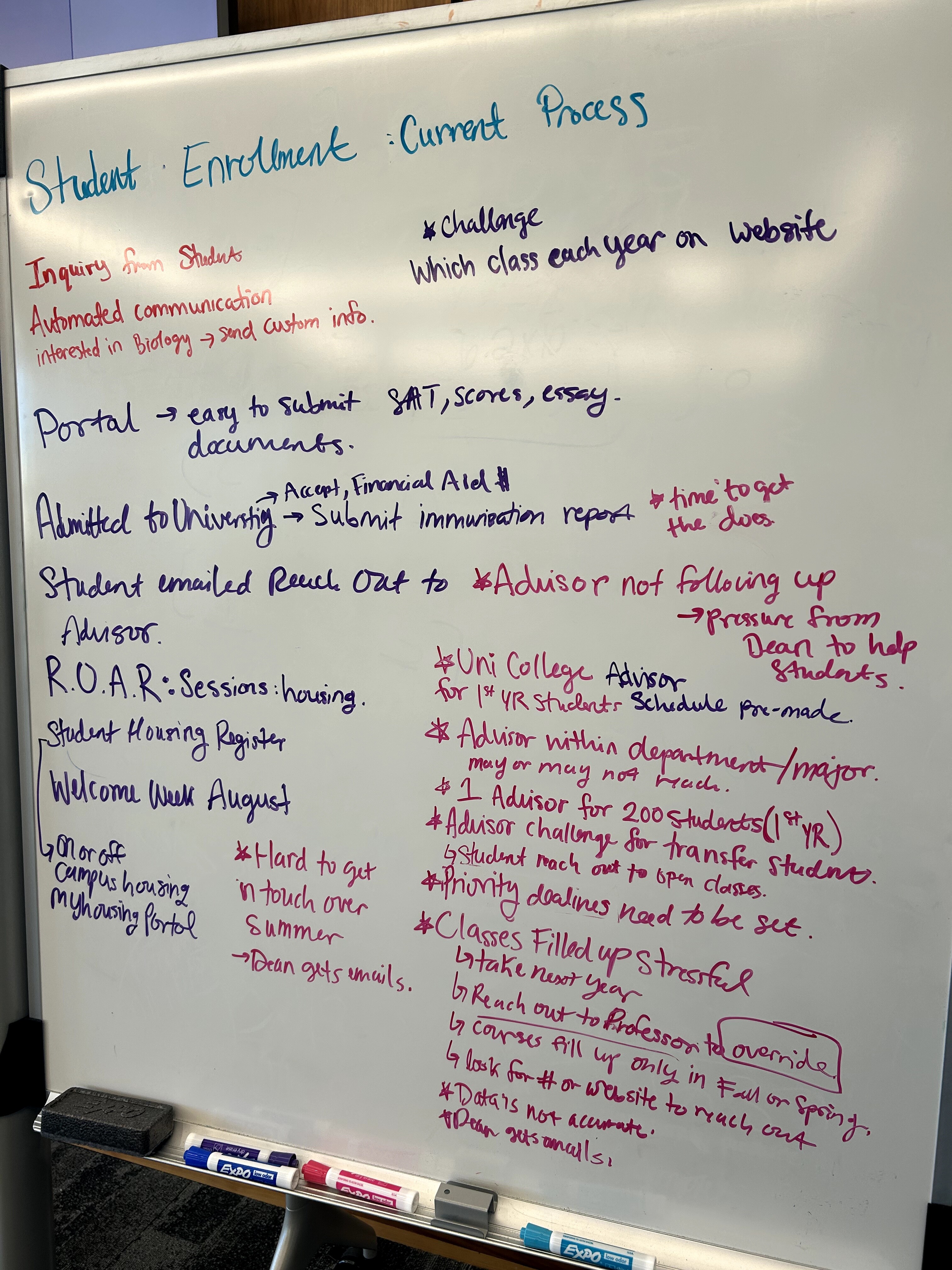
Student Enrollment Current Process
User Research Key Insights
During the workshop, I interviewed 10 current students at the University about their positive and negative experiences while going through the admissions process.
Key Challenges:
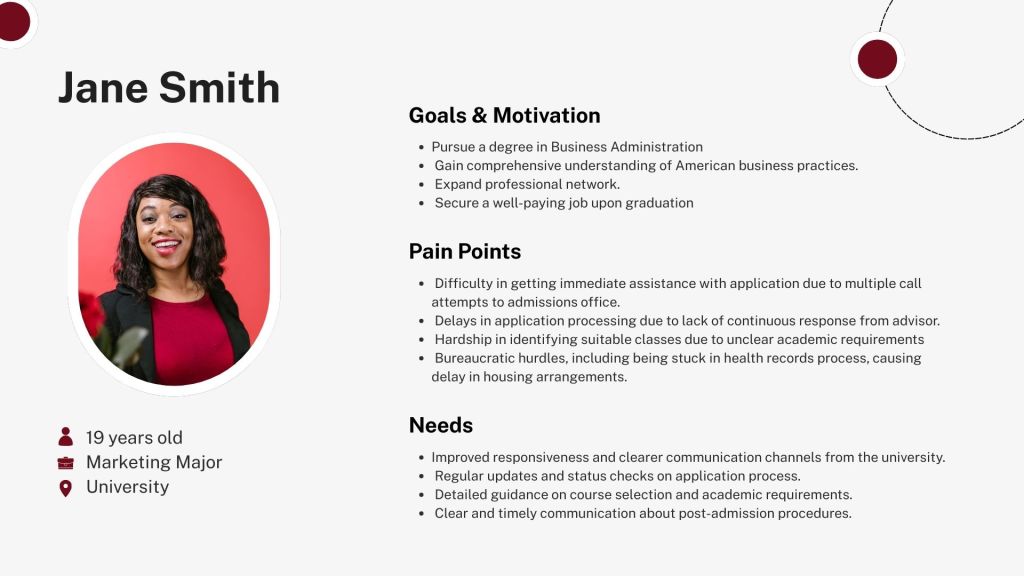
- “Having to call the office of admissions multiple times for my application to be processed”
- “Lack of continuous response from advisor”
- “Had to call to understand which classes to take as a freshman”
- “After getting admitted, no clear communication of next steps. As a result, didn’t register on time and had no housing”
| Insight | Evidence | Design Implication |
|---|---|---|
| Students have to go through multiple channels before finding answers | “Had to call to understand which classes to take as a freshman” | Create a single trusted point of support |
| Need a bridge for advisor and student communications | “Lack of continuous response from advisor” | Automated emails sent to advisors through the assistant |
| Tone matters | Students wanted information that felt “approachable,” not robotic | Design assistant responses that feel conversational and reassuring |
| Escalation path needed | Some questions require human review | Define handoff rules and policies |
Student Persona
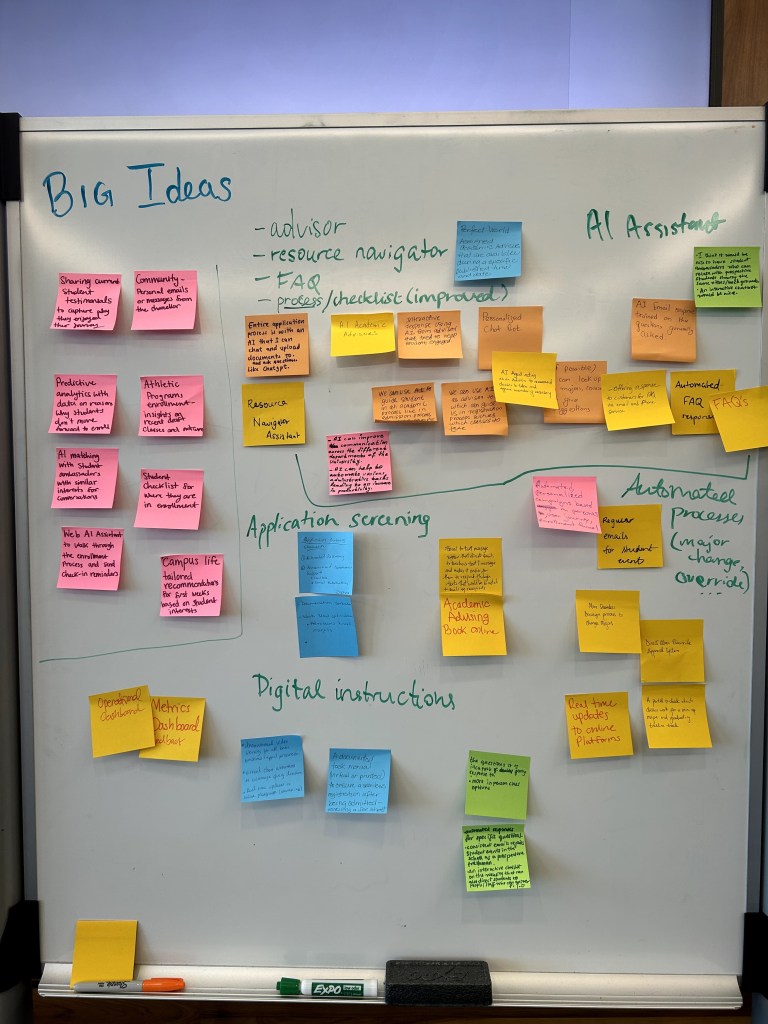
Magic Wand and Big Ideas
Solution
Through the design thinking process, the University and IBM identified the solution. An watsonx AI Assistant that will support the applicants experience with proactive application status updates, advisor connection facilitation, and automated response to admission FAQ’s.
04 — Service Ecosystem Mapping
We mapped the current admissions support experience to understand interactions across:
- Website content
- Student portal
- Admissions staff workflows
- CRM and knowledge base systems
This helped identify gaps between frontstage communication (what students see) and backstage processes (how information is managed and delivered).
05 — Service Blueprint
- User actions: Asking questions via web or portal
- Frontstage touchpoints: Chat UI, tone guidelines, suggested prompts
- Backstage processes: Intent mapping, knowledge retrieval, escalation logic
- Technology systems: CRM, knowledge base, authentication rules
- Policies:
- When to hand off to the University team of advisors
- Data privacy and access permissions
This blueprint aligned stakeholders across departments and defined how the assistant would operate at scale.
06 — Prototyping & Development
Prototype Capabilities
- Proactive Application Status Updates
- Advisor Connection Facilitation
- Automated Response to admission FAQ’s
Conversational Design
We designed a structured intent model to support:
- Top admissions inquiries
- Eligibility checks
- Step-by-step guidance (e.g., transcripts, financial aid, application status)
Tone and Communication
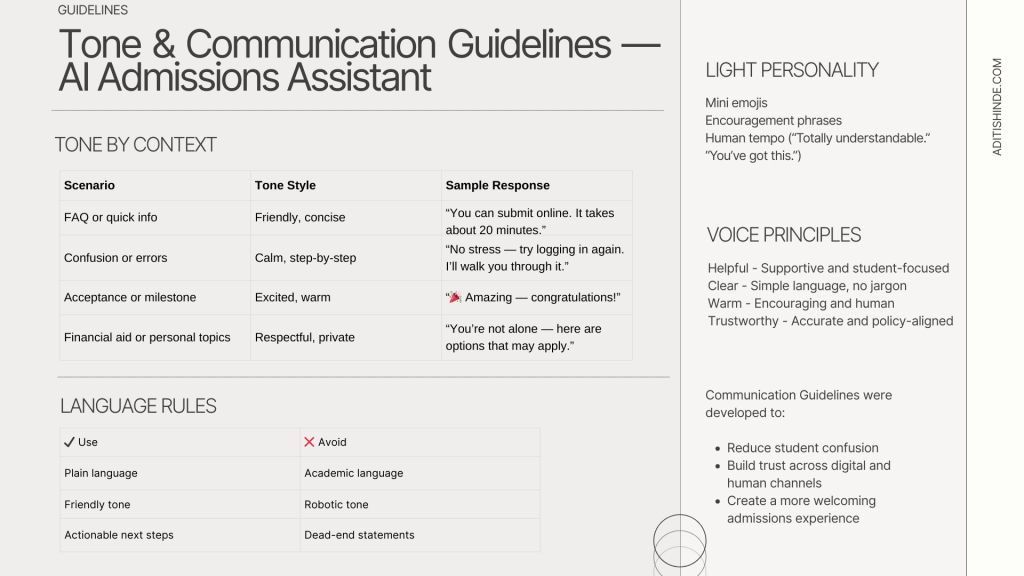
Students tested early flows, providing feedback on clarity and tone.
07 — Testing & Iteration
What We Tested:
- Information clarity
- Response tone and helpfulness
- Error recovery and escalation points
- Expectation management (what the assistant can vs cannot do)
Adjustments Made:
- Simplified language to remove academic jargon
- Added “suggested question” chips for usability
- Clarified escalation paths for edge cases
08 — Business Value and Impact
While implementation was handled by another phase of the organization, projected outcomes based on prototype testing and feasibility analysis included:
- Improved prospective students experience by making it easier for students to get FAQ’s answered and schedule academic advisor appointments during the application process
- Get application status updates in real time which would improve transparency and the need for manual follow up with admissions staff
- Reduced repetitive inquiry load for admissions teams
- Faster, on-demand access to admissions information
- A scalable foundation for future AI student services (financial aid, advising, housing)
09 — Handoff & Next Steps
The project was handed off to the deployment teams responsible for full production implementation.
10 — Reflection & Learnings
What I learned:
- Service design requires aligning multiple stakeholders and systems—not just the user interface.
- Policies play a crucial role in defining boundaries for conversational AI (accuracy rules, legal compliance, escalation).
- Early prototyping helps shape scope and prevent overbuilding before learning.
What I’d do differently next time:
- Expand user testing to include users from various background
 Aditi Shinde